
Fleet tire costs rarely blow up because of one big mistake. They creep up from small, repeated decisions: pulling tires too early, replacing when a retread would do, or skipping regrooving because "it feels risky." The result is predictable—higher cost per kilometer, more downtime, and less usable casing value left when it's finally time to retread.
This article lays out a simple, compliance-first lifecycle plan for eligible 53‑ft trailer tires: Regroove (when eligible) → Retread (when casing is still healthy) → Replace (only when necessary). It's not theory. It's a practical framework you can apply across a yard, with clear gates and documentation.
1) The goal: reduce cost per kilometer (not just "tire spend")
Most fleets track tire spend per month. The better metric is:
- Cost per kilometer
- Downtime cost (yard time, dispatch disruption, technician time)
- Casing preservation (keeping the tire retreadable)
A tire that gets replaced "early" might look safe on paper, but it can be the most expensive outcome if it throws away usable tread and damages casing value.
2) Where regrooving fits (and where it does not)
Regrooving is not for every tire and not for every axle. The cleanest way to think about it is: Regrooving is a controlled way to access unused tread rubber that's already designed into a regroovable tire—when the tire is eligible.
Regrooving is NOT:
- A fix for damaged casings
- A way to "save" unsafe tires
- For steer or drive axles
- For non‑regroovable tires
- For curved/zigzag patterns (service limitations apply)
For trailer fleets running straight-rib patterns on 53‑ft trailers, regrooving can be a high-ROI step if you keep it compliance-first and consistent.
3) The 3-gate lifecycle decision (simple and repeatable)
Use this decision flow for each trailer tire:
Gate A — Eligibility (pass/fail)
A tire is a regrooving candidate only if it meets all of the following:
- Marked REGROOVABLE by the manufacturer
- Straight-rib pattern (trailer application)
- Trailer axle only (not steer/drive)
- Never previously regrooved
- No visible casing/sidewall/belt damage
- Passes pre-inspection (condition + tread depth check)
If it fails any item, it's not a regroove tire. Move to retread/replace decision.
Gate B — Timing (too early / ideal / too late)
- Too early: you're cutting before the tire has "earned" it; you may reduce flexibility in lifecycle planning.
- Ideal window: enough wear that regrooving meaningfully extends life, but casing is still healthy and stable.
- Too late: if the tire is already near end-of-life, you may not get meaningful runway and you risk wasting time.
(Your exact thresholds should match your fleet's tire model and operating conditions. The key is consistency.)
Gate C — Documentation (proof for safety + consistency)
The fleets that win long-term are the ones that can prove what they did:
- Pre-measurement and post-measurement
- Consistent depth control
- Marking/identification of serviced tires
- A simple service log you can keep on file
4) ROI: why lifecycle planning beats one-off decisions
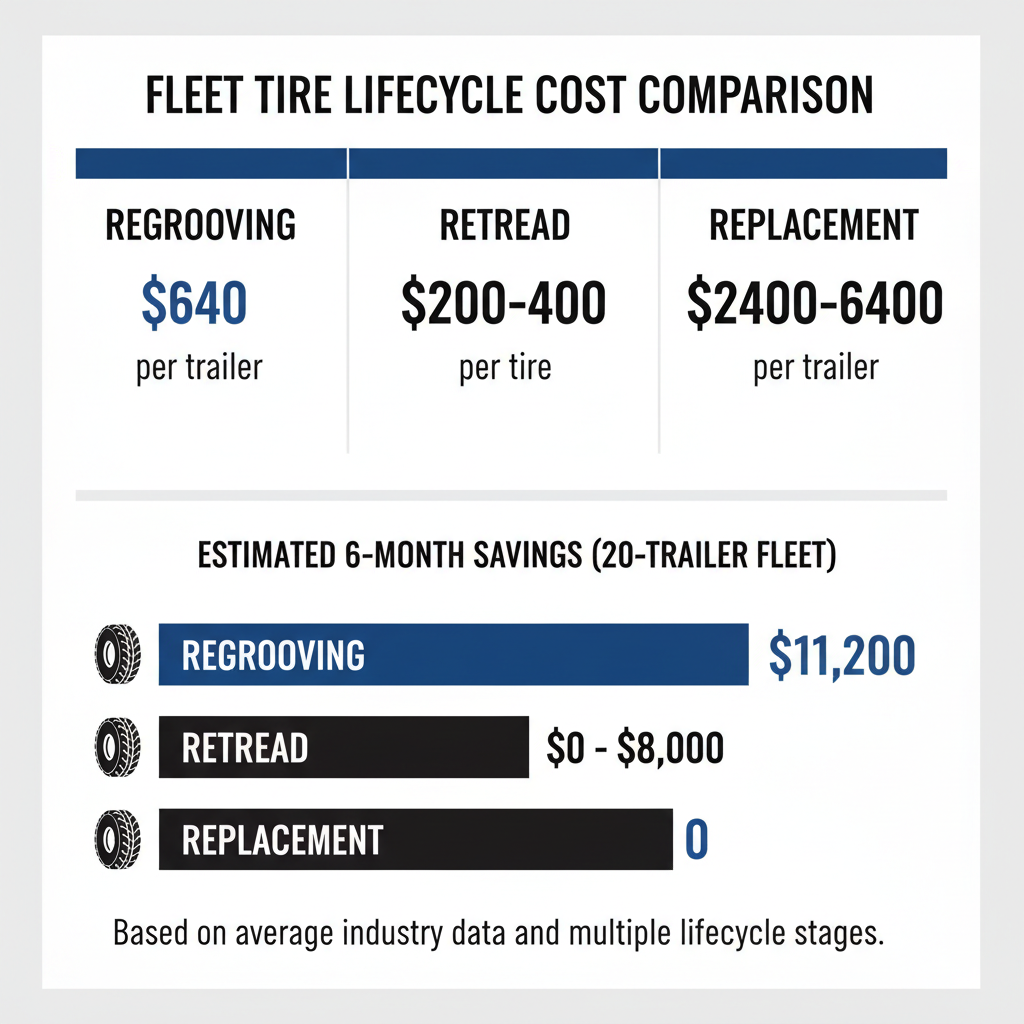
Here's the simplest ROI logic for regrooving on trailer tires: You pay a flat service cost per tire. You recover additional usable tread depth (controlled). You defer replacement. You keep the casing in a healthier state for retreading.
Even if you ignore every other benefit, deferring replacement by months across a fleet creates real cash flow relief. Add downtime reduction (on-wheel service, no wheel removal) and the operational ROI becomes even clearer.
A practical fleet math example (illustrative)
- Trailer has 8 tires
- Regrooving cost: $80/tire
- Cost per trailer (all 8): $640
If regrooving helps you avoid replacing even a portion of those tires early—or buys you enough time to align replacements with planned maintenance windows—the savings can exceed the service cost quickly. The biggest "hidden" savings is not just tire price; it's avoiding unplanned downtime and preserving casing value for retread.
5) The "hidden savings" most fleets miss
Hidden saving #1: downtime compression
If your process requires wheel removal or sending units out, you pay in: technician time, bay congestion, dispatch disruption, missed utilization. An on-wheel, in-yard process can compress downtime into a predictable yard workflow.
Hidden saving #2: casing value protection
A casing that stays healthy is an asset. A casing that gets abused, run underinflated, or damaged is a write-off. A compliance-first regrooving process is designed to be controlled and repeatable, which supports casing preservation.
Hidden saving #3: standardization across the yard
The fastest way to lose ROI is inconsistency: different decisions by different people on different days. A simple gate-based policy makes the outcome predictable.
6) How to operationalize this in your yard (without chaos)
If you want regrooving to be a system (not a one-time experiment), do this:
- Start with a 2-trailer pilot
Pick two trailers parked together. Keep it controlled. - Pre-qualify tires before scheduling
Confirm regroovable marking + straight-rib + trailer axle. - Batch service day planning
Stage trailers, confirm access, and keep the flow smooth. - Keep documentation simple
A paper log + tire marking is enough to start. Consistency matters more than fancy software.
For planning help, see: How to Plan a Batch Service Day for Trailer Tire Regrooving
7) Next steps (what to do this week)
If you manage a trailer fleet and want a clear, documented lifecycle plan:
- Step 1: Confirm which of your trailer tires are marked REGROOVABLE
- Step 2: Identify a small batch (2 trailers) parked together
- Step 3: Run a documented pilot and review results with your maintenance lead
Book a 2-trailer pilot this week
We'll confirm eligibility before we schedule. $80/tire. On-wheel. In-yard. Documented results.
Related Reading
Next Steps:
- Confirm which of your trailer tires are marked REGROOVABLE
- Identify a small batch (2 trailers) parked together
- Run a documented pilot and review results with your maintenance lead