If you manage a 53-ft trailer fleet, you have probably heard mixed opinions about tire regrooving: ‘it’s illegal’, ‘it hits the steel belts’, or ‘it won’t pass inspection’. The reality is simpler: regrooving can be legal and compliant when it is done on the right tires, on the right axles, with a controlled and documented process.
At Apex Tread Recovery, we are compliance-first. We regroove on-wheel, in-yard, on eligible trailer tires that are manufacturer-marked REGROOVABLE, with a controlled depth limit and a strict pre-inspection gate. The goal is not to ‘push’ a tire beyond what is reasonable. The goal is to recover usable tread depth in a controlled way, while protecting casing value.
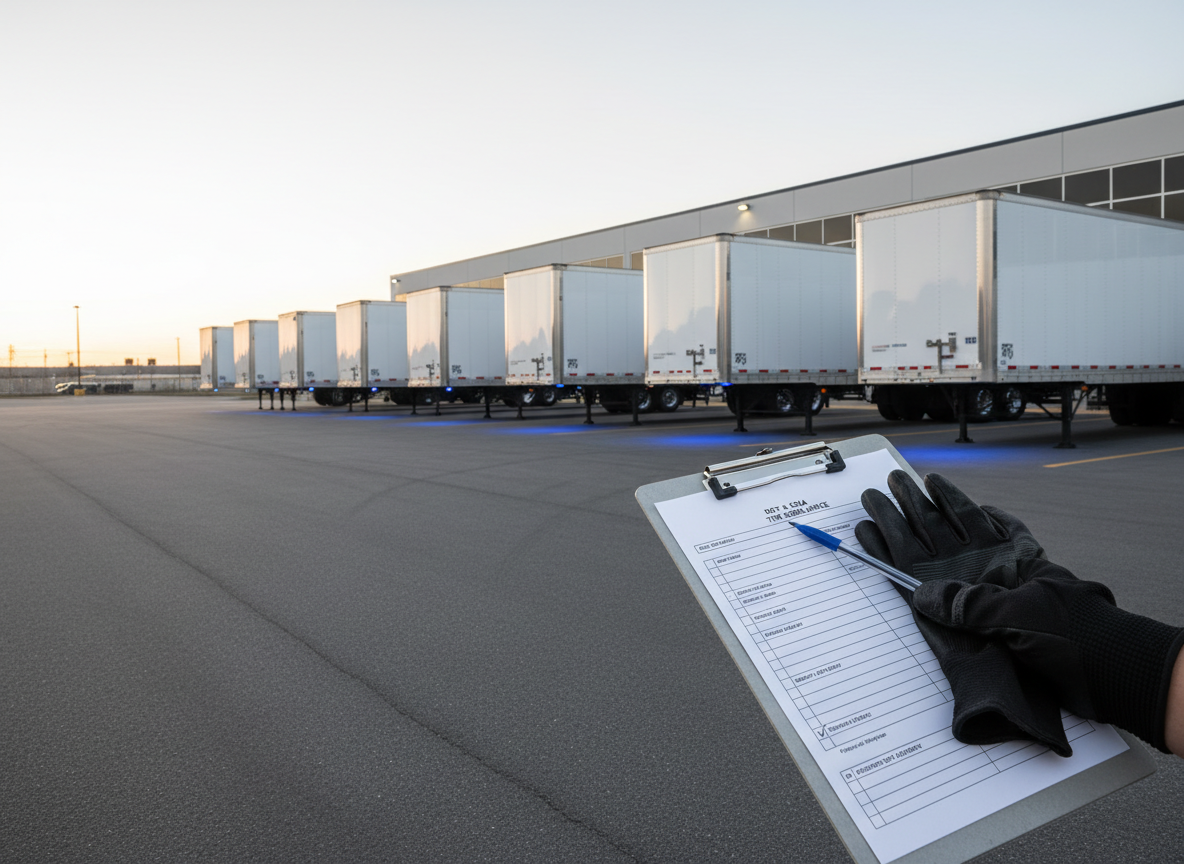
Compliance is built on eligibility, depth control, and documentation.
What this post covers
- What ‘compliant’ means in practical fleet terms
- Which tires and conditions are acceptable (and which are rejected)
- Why controlled depth is the key to avoiding steel belts
- What documentation to keep on file to reduce disputes
If you want the basics first, read our tire regrooving fundamentals guide. If your main question is financial impact, see our fleet cost optimization and ROI analysis. Tire regrooving fundamentals and fleet cost optimization & ROI.
1) Legality and compliance: what matters in practice
For a fleet, ‘compliant’ means the tire is eligible per the manufacturer, the application is appropriate (trailer axles), and the work is controlled (depth-limited, pattern-following, inspected, and documented). Regrooving is not guesswork. When applied correctly, it is a recognized maintenance practice.
At Apex, we keep the scope narrow on purpose: eligible 53-ft trailer tires only, straight-rib patterns only, and only when the sidewall shows the manufacturer REGROOVABLE marking. If there is ambiguity, we do not service the tire.
2) What we accept (and what we reject)
Accepted
- Trailer tires marked REGROOVABLE by the manufacturer
- Straight-rib tread patterns (repeatable, pattern-following grooves)
- Never previously regrooved
- Passes pre-inspection (casing/sidewall/belt integrity)
Rejected
- No REGROOVABLE marking on the sidewall
- Previously regrooved tires (double-service risk)
- Visible casing/sidewall/belt damage or questionable history
- Steer/drive axles and non-compatible patterns
For the most common objections (legality, inspection pressure, eligibility rules), the eligibility and safety FAQ is the fastest way to align your team. Read the FAQ.
3) The #1 safety fear: cutting too deep
The main fear is consistent: ‘what if it touches the steel belts?’ That is exactly why depth control matters more than marketing. A controlled, depth-limited process is designed to keep a protective rubber layer above the belts.
At Apex, the cut depth is mechanically limited. The goal is to recover usable tread depth in a stable way, without getting close to the belts. If a tire is risky, it is rejected. The best regrooving job is the one you do not do when conditions are not right.
4) Why on-wheel, in-yard service supports compliance
On-wheel service reduces handling and downtime. Less handling means fewer chances of damage and less confusion about which tires were serviced. The work is repeatable, the inspection gate is clear, and documentation is produced on-site.
For a clear walk-through of the workflow, see how our on-wheel regrooving service works. For the full scope and limits, review the service page. How it works and service details.
5) Documentation: reduce disputes, increase confidence
In the real world, compliance is not only doing the work correctly. It is also being able to explain what was done, on which tires, and within what limits. That is why we stick to a simple, repeatable approach: pre-inspection, measurement, controlled process, and post-inspection.
Recommended compliance file (per yard visit)
- List of trailers serviced and tire count
- Pre-inspection notes (including rejects)
- Paper depth report with before/after readings
- Photos (optional but useful for audits)
- Tire marking protocol (stamp) to prevent double-service
If you want to connect compliance to cost impact (without vague promises), re-read our fleet cost optimization and regrooving ROI analysis. Fleet cost optimization & ROI.
6) Why a 2-trailer pilot is often the best first step
If you have never done in-yard regrooving before, the simplest way to start is small, with a documented result. A pilot lets you validate eligibility, workflow, and the quality of the grooves on your own equipment before scaling.
- You pick 2 trailers (ideally parked together)
- We pre-inspect and only service eligible tires
- You receive documentation you can keep on file
For the pilot details, review the documented 2-trailer pilot program. For simple pricing, see the flat-rate pricing page. 2-trailer pilot program and pricing.
Conclusion
DOT/CSA compliance, in practice, comes down to three things: eligible tires, controlled depth, and inspection plus documentation. If you want a cautious, clear, trailer-focused approach for 53-ft units, that is exactly what this method is designed to deliver.
Book a 2-trailer pilot this week
$80/tire. On-wheel. In-yard. Documented results. We confirm eligibility during pre-inspection.
If you want a refresher on the eligibility gates, read our tire regrooving fundamentals guide. Tire regrooving fundamentals.