

If you manage a fleet of 53-ft trailers, you already know that tire maintenance is one of the biggest scheduling headaches. Coordinating shop visits, managing wheel removals, and absorbing multi-day turnarounds eats into your operational capacity. A batch service day is designed to eliminate all of that friction.
A batch service day is a scheduled yard block where we service multiple trailers in a continuous production loop. Instead of one-off calls, you stage a group of trailers together and we work through them sequentially — on-wheel, in-yard, no wheel removal. The result: 10 to 30 trailers serviced in a single day, all back in rotation by end of shift.
What this article covers
- How to prepare your yard and trailers for a batch service day
- What information we need from you before scheduling
- Realistic timelines: how many trailers you can run in one day
- Common mistakes that slow down batch days (and how to avoid them)
- What documentation you receive after the service
Why batch service days exist
The economics of on-wheel regrooving improve dramatically when trailers are grouped together. A single trailer takes approximately 20 minutes. But if that trailer is parked across the yard from the next one, you lose time on repositioning. When trailers are staged in a block, the transition between units is nearly zero — and the entire day runs like a production line.
For fleets running 10 or more trailers, a batch day is the most efficient way to get maximum value from the service. It also gives you a single, clean documentation package for the entire yard visit — useful for compliance records and internal audits.
If you want a refresher on the on-wheel process itself, read our guide on on-wheel regrooving and operational efficiency.
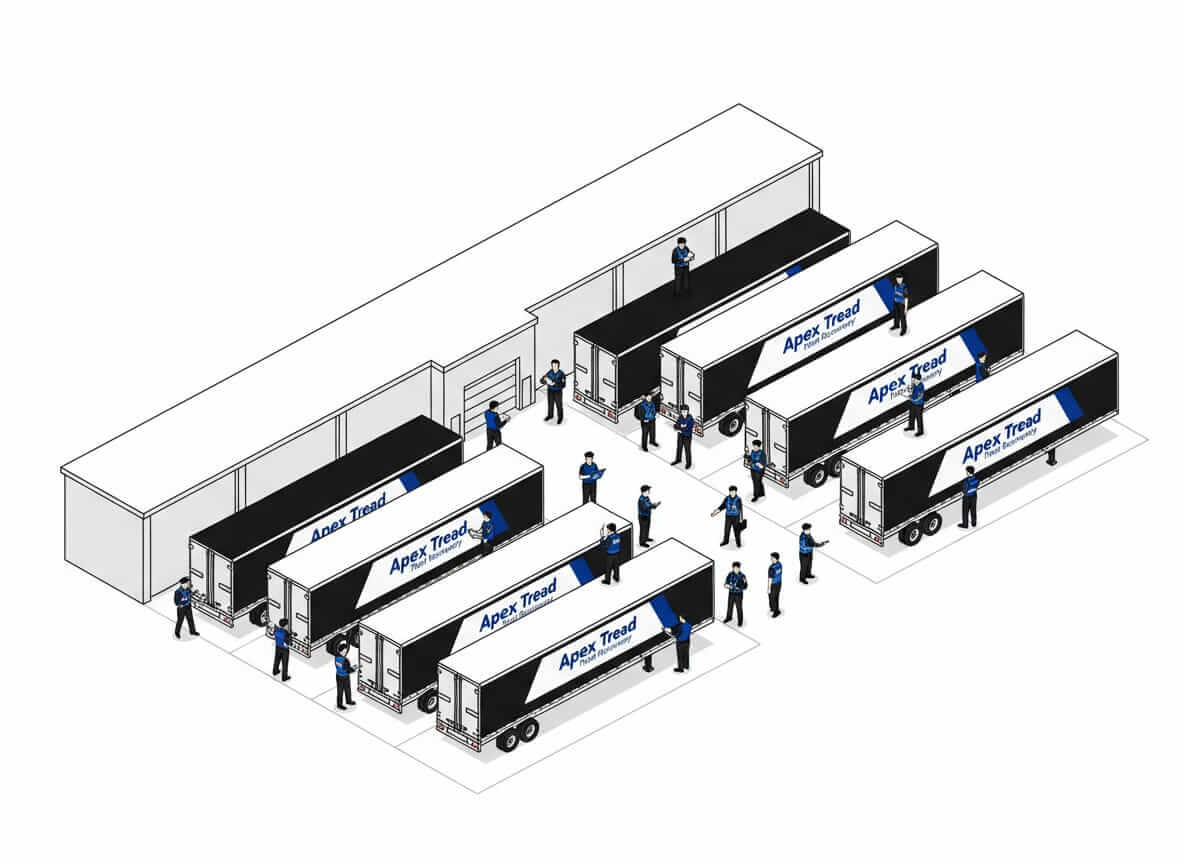
Batch service days work best when trailers are staged together in a block
How to prepare your yard and trailers
The single biggest efficiency gain is staging. If trailers are parked together in a block, the transition between units is nearly zero. If they are scattered across the yard, repositioning eats into the production rhythm. Here is what we ask fleet managers to do before a batch day:
- Park trailers in a block (or as close together as your yard allows)
- Confirm tires are straight-rib and manufacturer-marked REGROOVABLE
- Assign an on-site yard contact (name + phone) for the day
- Share gate access instructions, PPE rules, and any yard safety requirements
- Ensure a continuous service window — we work sequentially with no gaps needed between trailers
If you cannot stage all trailers together, the service is still possible — it just takes longer between units. Staging is the single most impactful thing you can do on your end to maximize the number of trailers serviced in a day.
Realistic timelines: how many trailers in one day
| Trailers | Tires (est.) | Time (est.) | Cost |
|---|---|---|---|
| 5 | 40 | ~2 hours | $3,200 |
| 10 | 80 | ~3.5 hours | $6,400 |
| 20 | 160 | ~7 hours | $12,800 |
| 30 | 240 | ~10 hours | $19,200 |
Estimates assume 8 eligible tires per trailer and ~20 minutes per trailer. Actual count depends on pre-inspection results. Ineligible tires are skipped at no charge.
For a 10-trailer block, the math is straightforward: 10 trailers × 20 minutes = approximately 3.5 hours of continuous service. All 10 trailers are back in rotation by midday. For a 20-trailer block, that is a full working day — but every trailer is back in service by end of shift. No multi-day shop turnaround. No staggered scheduling.
Common mistakes that slow down batch days
Mistake
- Trailers scattered across the yard (repositioning adds 5–10 min per trailer)
- No on-site contact available (delays when access issues arise)
- Mixing tire patterns in one request (non-straight-rib tires are rejected during pre-inspection)
- No gate instructions or PPE info shared in advance
Best practice
- Stage trailers in a block the night before
- Assign a yard contact with a cell phone
- Pre-check that tires are straight-rib and marked REGROOVABLE
- Email gate codes and PPE rules before the service date
The difference between a smooth batch day and a slow one is almost always preparation, not the service itself. The regrooving process is consistent — the variable is yard logistics.
For a detailed look at the on-wheel process itself, see our guide on on-wheel regrooving and operational efficiency. For eligibility rules and common objections, visit the FAQ page.
What documentation you receive after the service
Every batch service day produces a complete service record. This is not optional — documentation is built into the workflow because it serves two purposes: proof of compliance for DOT/CSA inspections, and a maintenance record you can reference when scheduling the next service cycle.
What you receive after every batch day
- Paper depth report with before/after tread depth readings for every tire serviced
- Service log listing trailers serviced, tires serviced, and tires skipped (with reason)
- Apex stamp on each serviced tire to prevent accidental double-regrooving
- Before/after photos of each serviced tire (on request)
This documentation package is the same whether you service 2 trailers or 30. The difference is scale — a batch day gives you a single, clean compliance file for the entire yard visit instead of scattered records from one-off calls.
When to schedule your first batch day
If you have never done in-yard regrooving before, the simplest path is to start with a 2-trailer pilot. You see the pre-inspection gate, the depth-limited cut, and the documentation on your own equipment — before committing to a full yard block. Most fleets move to monthly batch servicing within 30 days of their pilot.
For the financial case behind batch servicing, read our guide on fleet tire cost optimization and ROI. For compliance and safety details, see our article on DOT & CSA compliance for trailer tire regrooving. To check eligibility, use the pre-qualification form.
Book a 2-trailer pilot this week
$80/tire. On-wheel. In-yard. Documented results. Validate the process on your own equipment before scheduling a full batch day.
If you want a refresher on the eligibility gates, read our checklist on how to tell if a trailer tire is regroovable. For foundational context, read tire regrooving fundamentals.