
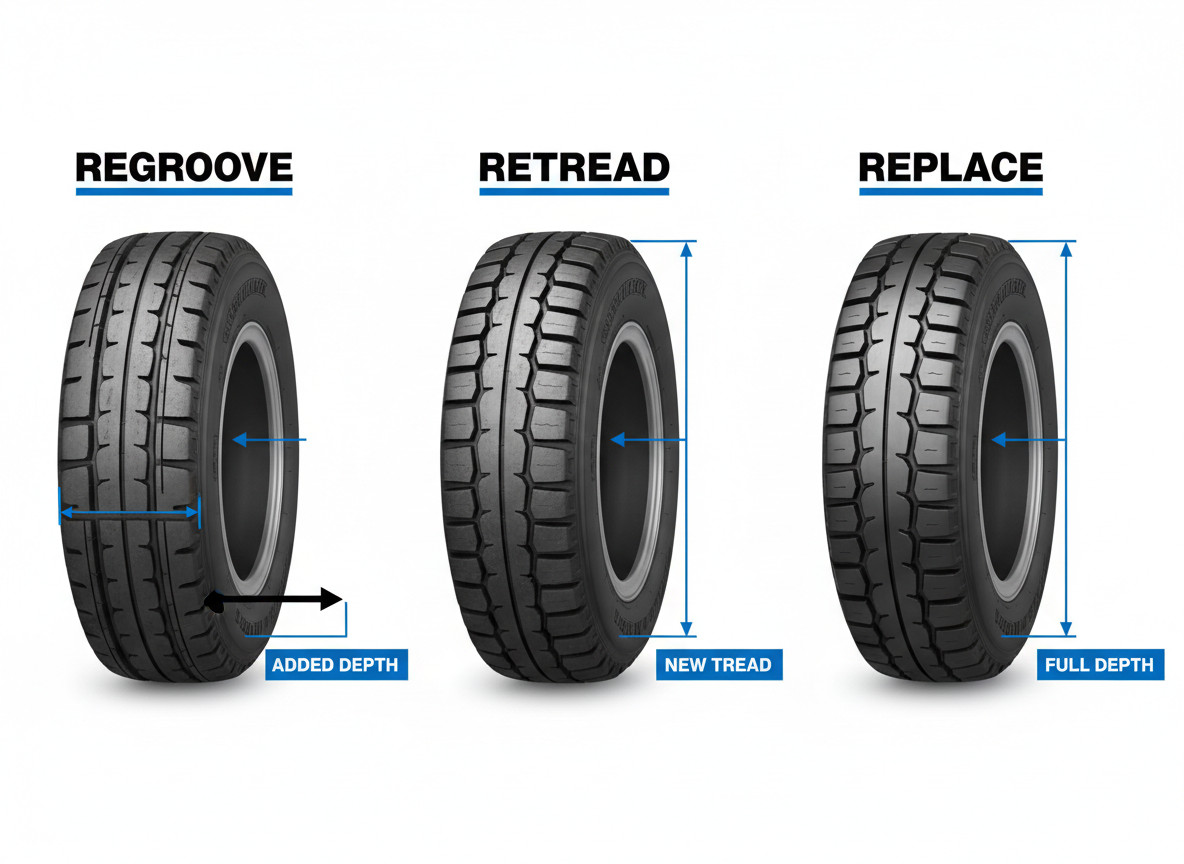
Every fleet manager faces the same recurring decision: a trailer tire is wearing down, and you need to decide what to do with it. Replace it now? Send it for retreading? Or is it still a candidate for regrooving? The wrong call costs money. The right call — made consistently across your entire fleet — can save tens of thousands of dollars per year.
This guide gives you a clear, tread-depth-based decision framework. It is not a sales pitch. It is a practical tool for fleet managers who want to get maximum value from each tire casing without cutting corners on safety or compliance.
What this guide covers
- Why tread depth is the starting point
- The decision framework: three options, three windows
- Regrooving eligibility criteria
- When retreading applies
- When replacement is the only option
- The optimal tire lifecycle sequence
- What this means in dollar terms
Why tread depth is the starting point
Tread depth determines which options are available to you. A tire with 6 mm of remaining tread is in a different situation than one with 2 mm. Understanding the thresholds — and what they mean for your options — is the foundation of any smart tire program.
For 53-ft trailer tires, the relevant thresholds are: the regrooving window (typically 2–4 mm remaining), the retreading window (after regrooving or when the casing is still healthy but tread is gone), and the replacement point (when the casing is no longer viable). Most fleets treat this as binary — replace or retread — and leave regrooving out of the equation entirely. That is a costly oversight.
If you want foundational context on what regrooving is and how it works, read our guide on tire regrooving fundamentals for 53-ft trailers. This guide assumes you already understand the basics.
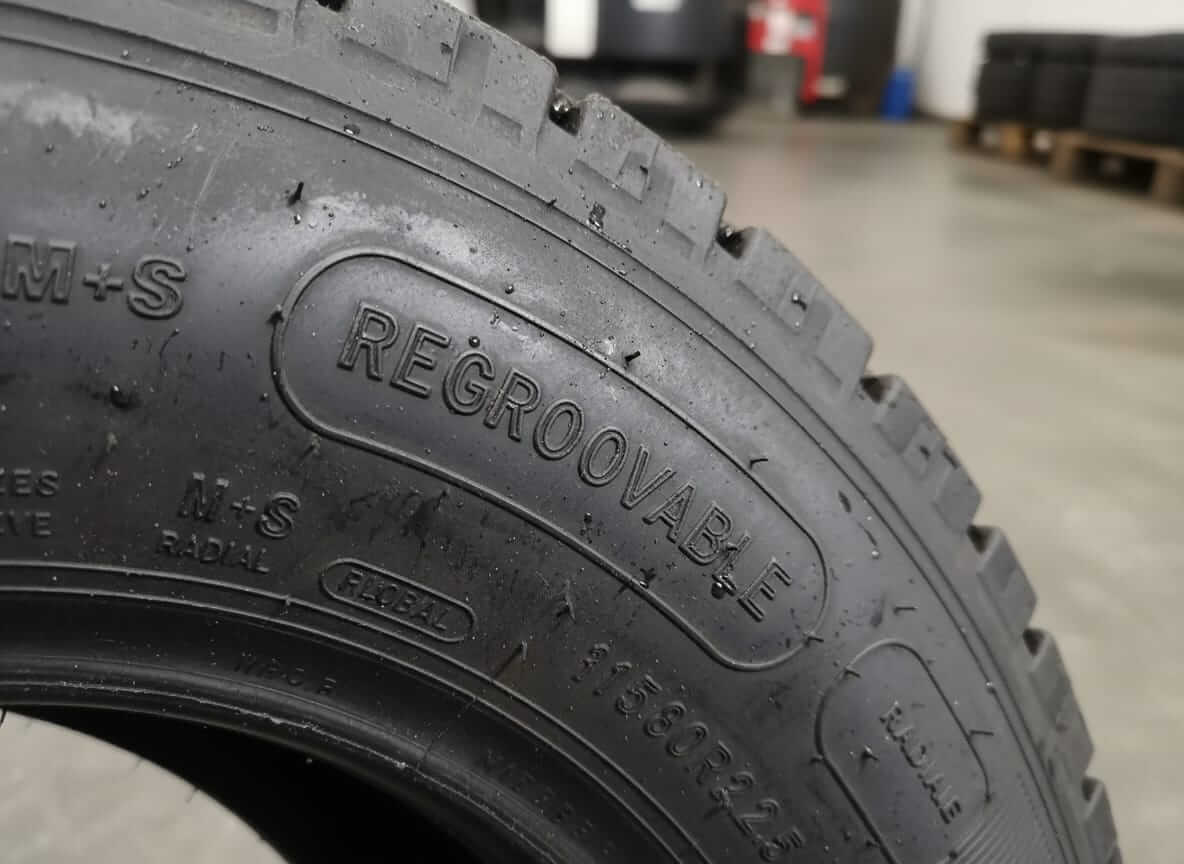
The REGROOVABLE marking on the sidewall is the first eligibility gate — without it, a tire cannot be regrooved
The decision framework: three options, three windows
Here is how to think about each option in practical terms:
1. Regrooving (2–4 mm tread remaining)
- Cost: $80/tire
- Time: ~20 minutes per trailer (8 tires)
- Result: Adds ~3 mm of depth; extends tire life by 30–35% (~50,000 km)
- Key advantage: Preserves the casing; tire can still be retreaded afterward
- Process: On-wheel, in-yard; no wheel removal required
2. Retreading (after regrooving or healthy casing, tread worn)
- Cost: $200–$400/tire
- Time: Wheel removal required; multi-day shop turnaround
- Result: Adds 50–60% additional tire life
- Key advantage: Economical for healthy casings
- Important: A correctly regrooved tire can still be retreaded after
3. Replacement (casing no longer viable)
- Cost: $300–$800/tire
- Result: New tire, full lifespan
- When: Belt damage, sidewall failure, casing cracks, or unverifiable history
- Opportunity cost: Highest of the three
Cost ranges are estimates based on typical market rates in Quebec and Ontario. Actual costs vary by supplier, tire brand, and region.
When regrooving applies: the eligibility gates
Regrooving is not available for every tire. It applies when all five of the following conditions are met:
Regrooving eligibility checklist (all five must be YES)
- ✓ Manufacturer-marked REGROOVABLE on the sidewall
- ✓ Straight-rib pattern only (no zigzag or curves)
- ✓ Trailer axle tires only (never steer or drive)
- ✓ No visible casing, sidewall, or belt damage
- ✓ Never previously regrooved; verifiable history
If a tire fails any of these gates, it moves directly to the retreading or replacement decision. Regrooving is not a fallback for tires that do not qualify — it is a precise intervention for tires engineered to accept it.
When retreading applies
Retreading is the right choice when the casing is still structurally sound but the tread is fully worn — and when the tire is no longer eligible for regrooving (either because it has already been regrooved, or because it was never marked regroovable). Retreading requires wheel removal and a multi-day shop turnaround, but it delivers 50–60% additional tire life at $200–$400 per tire.
Important: A tire that has been correctly regrooved — with a depth-limited process that preserved the casing — can still be retreaded afterward. Regrooving does not disqualify a tire from retreading. In fact, the optimal sequence is: regroove first, then retread when the casing is ready.
When replacement is the only option
Replacement is necessary when the casing is no longer viable: visible belt damage, sidewall failure, casing cracks, or a history that cannot be verified. It is also the default for tires that were never marked regroovable and have already been retreaded to the end of their life. At $300–$800 per tire, replacement is the highest-cost intervention — and the one most worth deferring when a lower-cost option is available.
The optimal tire lifecycle sequence
For eligible 53-ft trailer tires, the most cost-effective sequence is not a binary choice between retreading and replacement. It is a three-step process that maximizes the value of each casing:
- Step 1: Regrooving (2–4 mm tread remaining)
Adds ~3 mm; extends life by 30–35%. Cost: $80/tire. Result: Casing preserved, ready for retreading. - Step 2: Retreading (after regrooving, when tread is worn again)
Adds 50–60% additional life. Cost: $200–$400/tire. Result: Casing ready for final cycle. - Step 3: Replacement (casing finally no longer viable)
New tire, full lifespan. Cost: $300–$800/tire.
This sequence is not theoretical. It is the standard approach used by fleets that treat tire maintenance as a cost center to be optimized, not just a maintenance task to be completed.
What this means in dollar terms
For a fleet of 10 trailers (80 tires), the difference between skipping regrooving and including it in the lifecycle is significant. At $80/tire for regrooving vs. $500 average for replacement, you are deferring $420 per tire in replacement costs. Across 80 tires, that is $33,600 in deferred replacement costs per service cycle — before accounting for the retreading value you preserve by keeping the casing intact.
For a detailed breakdown by fleet size with savings tables, read our guide on fleet tire cost optimization and the ROI of regrooving.
How to apply this framework to your fleet
The fastest way to apply this framework is to run a 2-trailer pilot. You see the pre-inspection gate, the depth-limited cut, and the documentation on your own equipment — before committing to a full yard block. The pilot gives you real data: which tires qualified, what the before/after depth readings were, and how long the service took.
For the step-by-step on-site process, visit the How It Works page. To check eligibility for your fleet and book a pilot, use the pre-qualification form.
Book a 2-Trailer Pilot This Week
$80/tire. On-wheel. In-yard. ~20 minutes per trailer. Paper depth report included. We confirm eligibility during pre-inspection — you only pay for tires we actually service.
If you have questions about eligibility, safety, or the compliance side of regrooving, visit the FAQ page for direct answers to the most common fleet objections.