
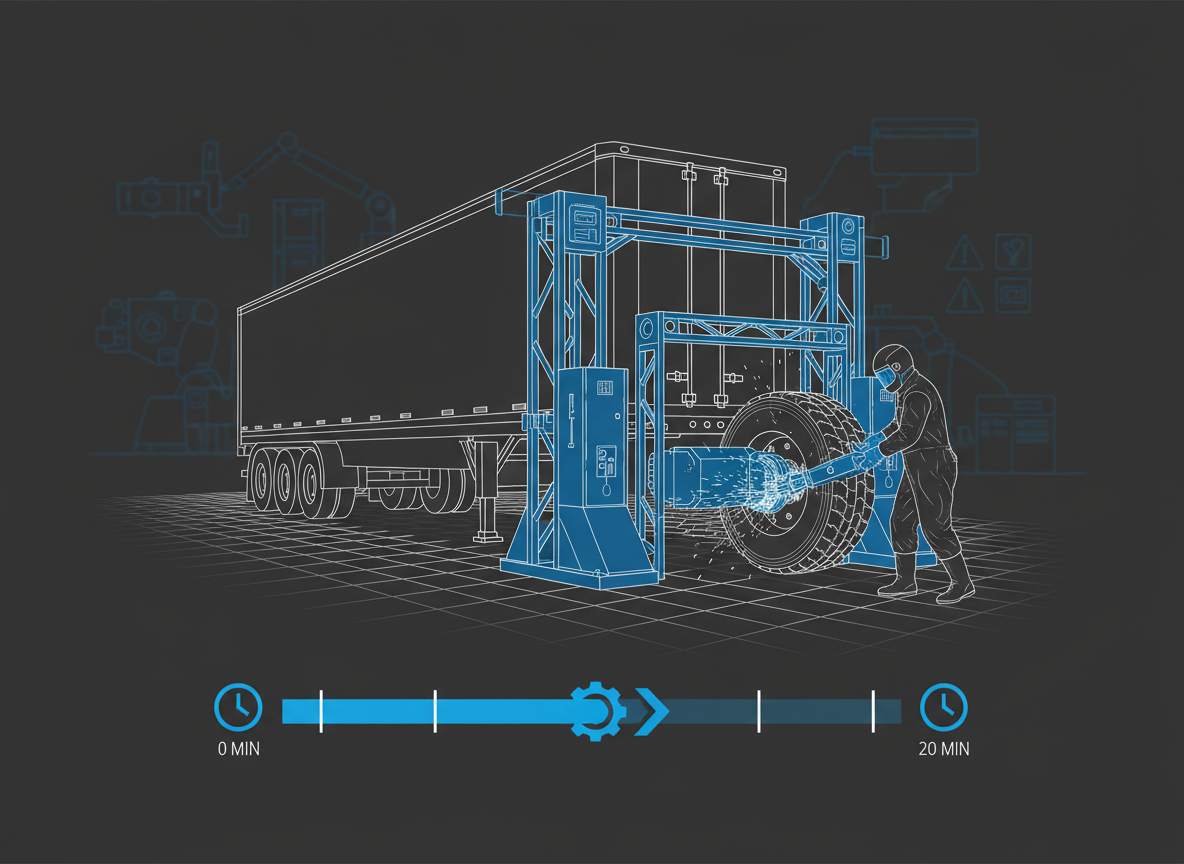
For fleet managers running high-utilization trailer operations, every hour of downtime has a cost. Tire maintenance is one of the most common sources of unplanned downtime — and one of the most avoidable. On-wheel, in-yard regrooving is designed specifically to eliminate the operational friction that comes with traditional tire service.
Traditional tire service — whether retreading or replacement — requires wheel removal, shop scheduling, and multi-day turnarounds. For a fleet running 20 or 30 trailers, that means coordinating trailer availability, managing shop queues, and absorbing the cost of trailers sitting idle. On-wheel regrooving removes all of those variables.
What this article covers
- Why on-wheel service eliminates the main sources of tire-related downtime
- How the 20-minute-per-trailer workflow fits into a yard schedule
- Batch service day logistics: how to run 10+ trailers in a single block
- Documentation and proof you receive after every service
The core operational advantage: no wheel removal
Wheel removal is the single biggest source of downtime in traditional tire service. It requires a lift, a technician, and a shop bay. It means the trailer is out of service for hours or days. And it means scheduling — which means lead time, coordination, and the risk of delays.
On-wheel regrooving eliminates all of that. The trailer stays parked. The tires stay on. We bring the gantry system to your yard, work through each trailer sequentially, and leave. The trailer is back in service as soon as we're done — typically within 20 minutes per trailer.
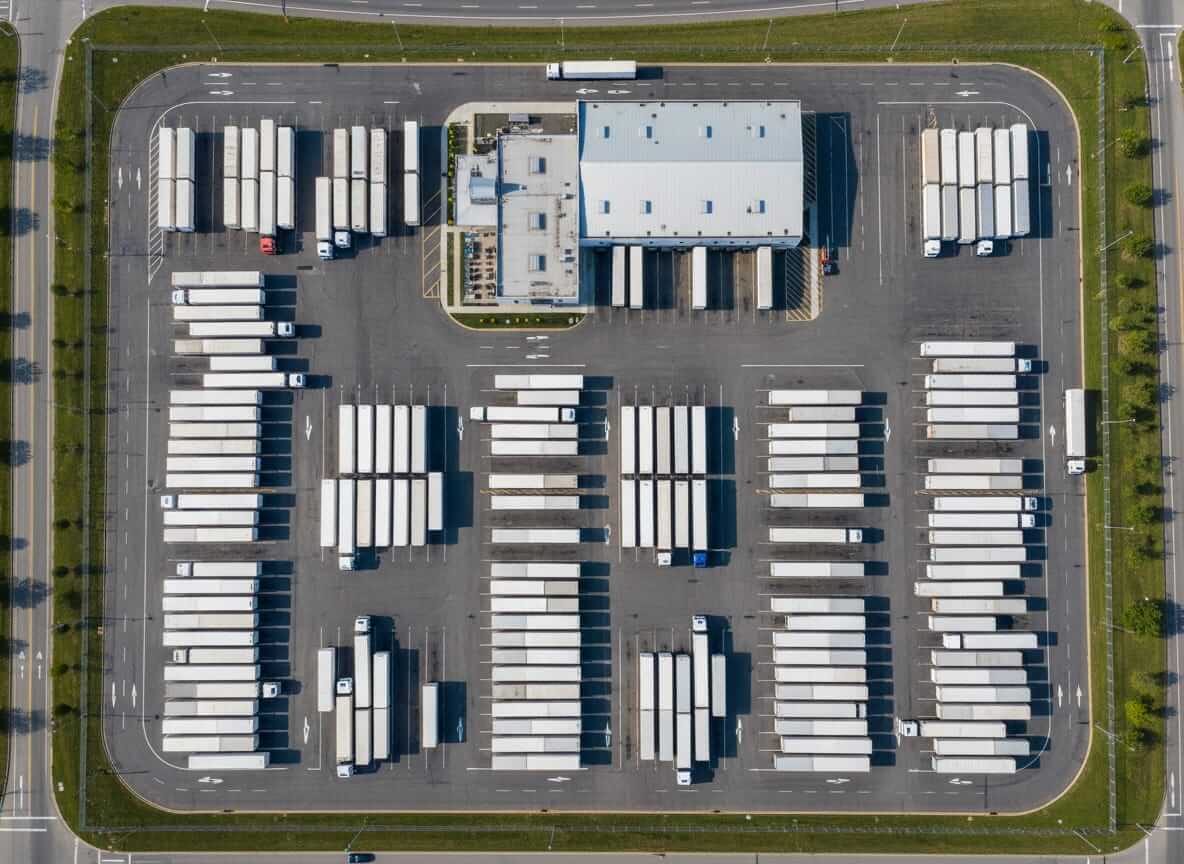
Large distribution yards with staged trailers are ideal for batch service days
The 20-minute workflow: what actually happens on-site
The on-site workflow is built around a continuous production rhythm. There is no setup time between trailers, no waiting for equipment to cool down, and no administrative delays. Here is what the sequence looks like for a typical yard visit:
Per trailer (~20 minutes)
- Arrival + staging check (confirm access and tire layout)
- Pre-inspection of all 8 tires (regroovable marking, pattern, casing, depth)
- Jack trailer as needed for access — wheels stay on
- Depth-limited regrooving on eligible tires (mechanical hard stop at 3 mm)
- Post-service depth measurement + tire stamping
- Move to next trailer — no reset time required
Typical yard block (10 trailers)
- →10 trailers × 8 tires = 80 tires maximum
- →~20 minutes per trailer = ~3.5 hours total
- →Trailers back in service same day
- →Paper depth report delivered after service
- →Ineligible tires skipped and documented — no charge
Batch service days: running 10–30 trailers in a single block
The most efficient way to use on-wheel regrooving is a scheduled batch service day. Instead of calling for one or two trailers at a time, you stage a block of trailers together and we work through them in a continuous production loop. This is how high-volume fleets get the most value from the service.
For a 20-trailer block, the math is straightforward: 20 trailers × 20 minutes = approximately 7 hours of continuous service. That is a full working day, with all 20 trailers back in service by end of day. No multi-day shop turnaround. No staggered scheduling. No trailers waiting in a queue.
What you need to prepare for a batch service day
Batch service days work best when trailers are staged together and accessible. Here is what we ask for before scheduling:
- Trailers parked in a block (or as close together as your yard allows)
- Confirmation that tires are straight-rib and manufacturer-marked REGROOVABLE
- An on-site yard contact (name + phone) for the day
- Gate access instructions and any yard safety requirements (PPE, speed limits, etc.)
- A continuous service window (we work sequentially — no gaps needed between trailers)
If trailers are scattered across the yard, service is still possible — it just takes longer between trailers. Staging them together is the single biggest efficiency gain you can make on your end.
Pre-inspection: the gate that protects your fleet
Every tire goes through a pre-inspection before regrooving begins. This is not a formality — it is the primary safety control in the process. Tires that do not pass are skipped and documented. You only pay for tires that are actually serviced.
The pre-inspection checks five things: manufacturer REGROOVABLE marking on the sidewall, straight-rib tread pattern, no previous regrooving, no casing or sidewall damage, and adequate remaining tread depth. Tires that fail any of these criteria are flagged for retreading or replacement instead.
Documentation: what you receive after every service
Every yard visit produces a complete service record. This is not optional — documentation is built into the workflow because it serves two purposes: it gives you proof of compliance for DOT/CSA inspections, and it gives you a maintenance record you can reference when scheduling the next service cycle.
What you receive after every yard visit
- Paper depth report with before-and-after tread depth readings for every tire serviced
- Before-and-after photos of each serviced tire (on request)
- Service log listing trailers serviced, tires serviced, and tires skipped (with reason)
- Apex stamp on each serviced tire to prevent accidental double-regrooving
How on-wheel service fits into a complete tire lifecycle
On-wheel regrooving is not a replacement for retreading or new tires. It is a step that extends the usable life of the tire before those more expensive options become necessary. For high-utilization fleets, the most efficient tire lifecycle looks like this:
- Run the tire until it reaches the regrooving window (typically 2–3 mm remaining tread)
- Regroove on-wheel, in-yard — adds ~30–35% more usable tread life (~50,000 km)
- Continue service until end of usable life — casing remains intact and retreadable
- Retread if the casing is healthy, or replace if not
This sequence maximizes the value of each tire casing. Because on-wheel regrooving does not involve aggressive machining or wheel removal, the casing remains in the best possible condition for future retreading.
Common scheduling questions
Fleet managers often ask the same practical questions before scheduling a service day. Here are the most common ones:
Can we run service while trailers are in active rotation?
Yes, as long as the trailer is parked and accessible for the ~20-minute service window. We work around your yard schedule — trailers do not need to be pulled from rotation in advance.
What if some tires don't pass pre-inspection?
Ineligible tires are skipped and documented. You only pay for tires that are actually serviced. The pre-inspection report tells you which tires were skipped and why — useful information for your next maintenance decision.
How far in advance do we need to book?
For a 2-trailer pilot, we aim to schedule within the same week. For larger batch days (10+ trailers), we typically need 3–5 business days to confirm logistics and travel.
For a detailed look at the step-by-step on-site process, visit our How It Works page. To understand the cost savings and ROI for your fleet size, read our guide on fleet tire cost optimization and ROI. For compliance and safety details, see our article on DOT compliance and tire regrooving safety. If you have questions about eligibility, visit the FAQ page or use the pre-qualification form to submit your fleet details.
Book a 2-trailer pilot this week
$80/tire. On-wheel. In-yard. ~20 minutes per trailer. Documented results. We confirm eligibility during pre-inspection.
Book a 2-Trailer Pilot